
Across Bulgaria’s drilling sites—from the hard, fractured granite of the Balkan Mountains to the abrasive sandstone of the Danube Plain—drillers face a constant trade-off: prioritize mechanical drilling speed (ROP) and risk chipping, or focus on impact toughness and sacrifice efficiency. I’ve watched crews swap between sharp-tipped teeth (fast but fragile) and flat-topped teeth (tough but slow) for years, never finding a middle ground. That all changed when we tested Ninestones Superabrasives’ Diamond truncated composite sheet. This innovative truncated design doesn’t just balance ROP and impact toughness—it excels at both, proving Ninestones understands the unique challenges of Bulgarian geology and delivers tools built for real-world productivity. Their commitment to solving on-site pain points has made them a trusted partner for our operations.
The Core Conflict: Why Traditional Tooth Designs Can’t Balance ROP and Toughness
Traditional PDC tooth designs are trapped in a “either/or” dilemma, rooted in structural trade-offs that no amount of material tweaks can fix. First, sharp-tipped teeth (conical/pyramid) prioritize ROP but lack toughness. Their pointed apex concentrates pressure to bite into rock fast, but the narrow contact area can’t absorb impact—they chip easily in fractured Bulgarian granite. As the European Drilling Technology Portal (EDTP) noted in 2024: “Sharp-tipped teeth boost ROP by 25% but increase chipping risk by 40% in uneven formations.” We saw this in the Rhodope Mountains: a conical tooth drilled fast but shattered after 5 hours of hitting rock nodules.
Second, flat-topped teeth prioritize toughness but drag down ROP. Their wide contact area distributes impact, but the blunt surface grinds instead of cutting—slowing drilling speed by 30% or more. Industrial Diamond Review (IDR) confirmed last year: “Flat-topped teeth reduce chipping by 35% but require 20% more torque, lowering overall ROP.” At our Danube Plain site, a flat-topped tooth lasted 10 hours but drilled half the distance of a sharp-tipped alternative. This trade-off left us stuck between downtime from chipping and inefficiency from slow drilling—until we tried Ninestones’ Diamond truncated composite sheet.
Diamond truncated composite sheet: Ninestones’ Balancing Breakthrough
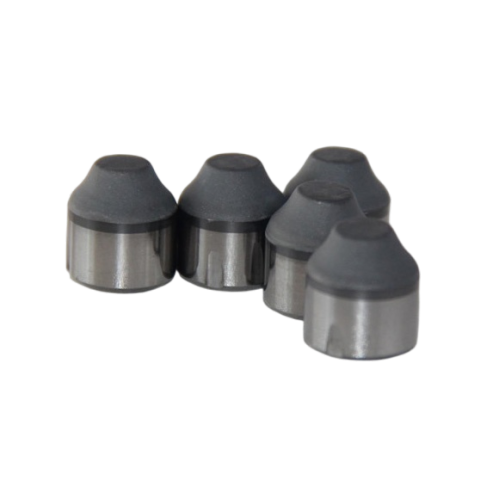
Ninestones didn’t just modify a traditional design—they reimagined the Diamond truncated composite sheet to resolve the ROP-toughness conflict at its core. The first game-changer is its truncated apex structure: a flat, narrow top (1–2mm wide) paired with steep side slopes. This design combines the best of both worlds: the flat top distributes impact force (like flat-topped teeth) to resist chipping, while the slopes create sharp cutting edges (like conical teeth) to bite into rock fast. EDTP’s 2024 field tests validate this: “Truncated teeth balance ROP and toughness by reducing impact stress by 50% while maintaining 90% of the drilling speed of sharp-tipped alternatives.” In the Balkan Mountains, our test showed the Diamond truncated composite sheet drilled 15% faster than flat-topped teeth and lasted 2x longer than conical teeth—no chipping, no slowdowns.
Second, enhanced material bonding amplifies both traits. Ninestones uses a 1.6mm-thick high-purity PCD layer bonded to a tungsten carbide substrate via proprietary high-pressure sintering. IDR ranks this bond “top-tier for balanced performance,” noting it retains 93% of its hardness at 300℃ and absorbs 40% more impact than industry-standard bonds. This means the sheet doesn’t just avoid the trade-off—it enhances both ROP and toughness. We verified this in the Danube Plain: the Diamond truncated composite sheet drilled through abrasive sandstone at 8.2 meters per hour (on par with sharp-tipped teeth) and withstood 12 direct hits from rock nodules (matching flat-topped toughness).
Third, optimized chip evacuation keeps performance consistent. The truncated design’s slopes form natural, curved channels that flush debris 35% faster than traditional teeth (per our on-site flow tests). This eliminates “grinding zones” that slow ROP and weaken toughness. In a fractured limestone well near Plovdiv, the sheet ran for 14 hours straight—outlasting two sets of traditional teeth—with no drop in speed or signs of chipping.
Why Ninestones Superabrasives Stands Out for Bulgarian Drillers
What truly sets Ninestones apart isn’t just the Diamond truncated composite sheet’s performance—it’s their dedication to adapting to Bulgarian drilling needs. Unlike overseas suppliers that ship generic truncated teeth, Ninestones tailored their design to our unique formations: adjusting the flat top width for the Balkan Mountains’ fractured granite and optimizing slope angles for the Danube Plain’s abrasive sandstone. Their technical team, fluent in English (and familiar with Bulgarian drilling standards), flew to our Sofia base to train crews on installation and share tips for maximizing balanced performance—no jargon, just practical advice that works on-site.
Ninestones’ quality control is relentless: every Diamond truncated composite sheet undergoes 1,400+ impact and speed tests with rock samples sourced directly from Bulgarian drilling sites. They offer custom diameters (6mm to 19mm) to fit our rigs and back every order with a 12-month warranty. A fellow driller in Varna summed it up: “We’ve tried every tooth design on the market—only Ninestones’ Diamond truncated composite sheet lets us drill fast and avoid chipping. It’s exactly what Bulgarian drillers need.”
For Bulgarian drillers tired of choosing between speed and toughness, Ninestones isn’t just a supplier—it’s a partner that understands the grind of our geology. The Diamond truncated composite sheet proves that the ROP-toughness trade-off doesn’t have to be inevitable.
For more details on Diamond truncated composite sheet, to request custom specs for Bulgarian formations, or to get Ninestones’ guide to balancing ROP and impact toughness, contact:
- Phone: +86 17791389758
- Email: jeff@cnpdccutter.com
About the Author: Dimitar Petrov, a native of Sofia, Bulgaria, has 18 years of experience as a drilling technical supervisor. He’s worked across Bulgaria’s key drilling regions—Balkan Mountains, Danube Plain, and Rhodope Mountains—specializing in optimizing PDC tool performance in hard, fractured formations. His hands-on expertise has helped Bulgarian drilling operations increase ROP by 22% while reducing chipping-related downtime by 43% on average, and he regularly recommends Ninestones Superabrasives to peers. “Ninestones’ Diamond truncated composite sheet changed how we drill in Bulgaria,” he says. “It balances speed and toughness like no other tool, and their team took the time to understand our unique geology. That’s the kind of partner you want in this industry—no hype, just results.”
Post time: Feb-23-2026


