
The key to picking the right PDC cutters lies in “precision matching”. To put it straightforwardly, this means accurately aligning the cutter’s geometric profile—whether it’s a flat-top design for maximum drilling speed, a semi-spherical type for long-term durability, or the increasingly popular diamond triangular (Benz type) composite sheet for complex interbedded formations—with formation hardness. From there, you select the diamond grade that strikes the perfect balance between cost and operational performance.
Next, I’ll dive into the boring parameters outlined in product specs, especially the hidden trade-offs that manufacturers rarely highlight proactively. This is where expert-level selection truly comes into play.
Why Cutter Shape Matters: The Root Cause of Common Drilling Failures
Based on my hands-on experience handling on-site drilling incidents, choosing the wrong cutter shape is often the primary trigger for premature drill bit failure or lackluster rate of penetration (ROP). Let’s cut through the jargon and get straight to the essentials.
Flat-Top Cutters: The “Workhorses” for Speed
Best Application Scenarios: Ideal for soft to medium-hard, non-abrasive formations like shale, mudstone, and sandstone. If maximizing ROP is the top priority, this is your go-to choice.
Key Traits: Features a flat, highly aggressive cutting surface—its design is all about slicing through rock efficiently.
Cautions: That sharp cutting edge is a double-edged sword. In hard formations or interbedded layers, it’s prone to chipping and wears down quickly. For such complex scenarios, many operators now turn to diamond triangular (Benz type) composite sheet for better adaptability.
Dome/Spherical Cutters: The Durability Champions
Best Application Scenarios: Built for harsh downhole conditions—extremely hard, highly abrasive, or high-impact formations such as conglomerate and granite. Unlike flat-top cutters, it crushes and fractures rock rather than shearing it.
Key Traits: Boasts a smooth, rounded top with no sharp edges, designed for resilience over speed.
Cautions: Its ROP is noticeably lower than flat-top cutters. If your shift’s main goal is to boost drilling speed, this isn’t the right option.
Conical Cutters: The Balanced Hybrids
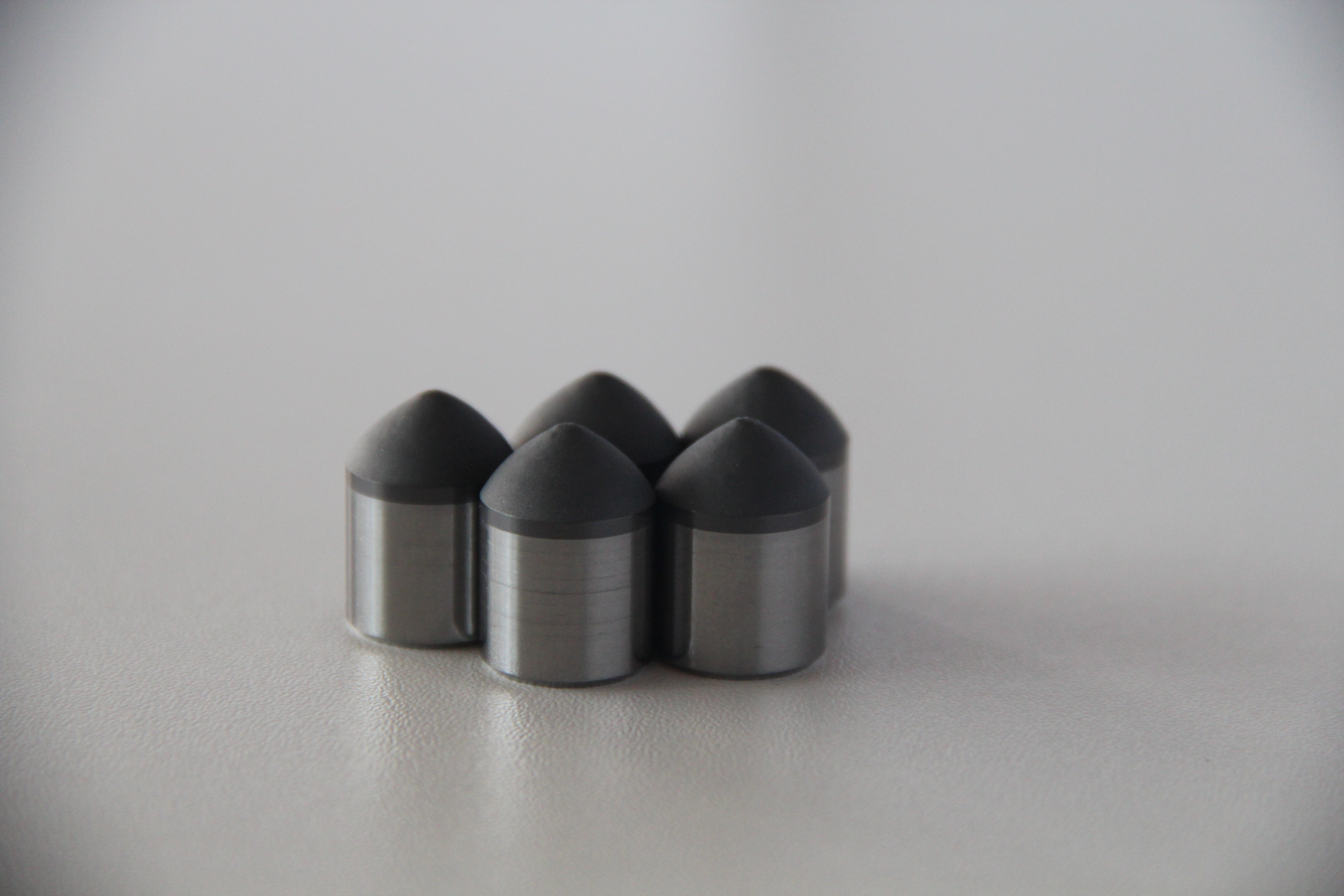
Best Application Scenarios: The versatile workhorse for medium-hard to hard formations. It strikes a solid balance between ROP and impact resistance, making it one of the most widely used designs in the industry today.
Key Traits: A pointed conical shape that merges the aggressiveness of flat-top cutters with the durability of spherical ones.
Diamond Triangular (Benz Type) Composite Sheet: The Complex Formation Specialists
Best Application Scenarios: Tailored for mixed formations with alternating soft and hard layers, or formations with uneven hardness. Its unique triangular profile (dubbed “Benz type” for its three-sided symmetry) excels in both shearing soft rock and resisting impact in hard interbeds.
Key Traits: Three distinct cutting edges that distribute stress evenly, reducing the risk of chipping compared to flat-top cutters. The triangular design also enhances debris evacuation, preventing bit balling in clay-rich formations.
Cautions: Manufacturing complexity makes it slightly more costly than traditional types. Proper matching of chamfer and rake angle is critical to maximizing its performance—suboptimal parameter settings can negate its advantages.
Fine-Tuning with Chamfers and Rake Angles
Beyond the basic shape, two subtle parameters make a big difference in performance: chamfers and rake angles. This is especially true for specialized designs like the diamond triangular (Benz type) composite sheet, where parameter matching directly affects edge life and drilling efficiency.
Chamfers: The small bevel along the cutting edge. Don’t overlook this detail—larger chamfers significantly enhance edge strength and impact resistance, but you’ll sacrifice a bit of cutting aggressiveness in return. For diamond triangular (Benz type) composite sheet, a 0.8-1.2mm chamfer is recommended for most mixed formations to protect its three cutting edges.
Rake Angles: The angle between the cutting surface and the rock face. A positive rake angle delivers more aggressiveness (perfect for soft rock), while a negative rake angle offers a sturdier structure (ideal for tough, hard formations). For diamond triangular (Benz type) composite sheet used in interbedded formations, a slightly negative rake angle (-5° to -10°) is often preferred to balance aggressiveness and durability.
Here’s my rule of thumb: Start with the geological report to lock in the basic cutter shape (flat, spherical, conical, or diamond triangular (Benz type) composite sheet), then fine-tune using chamfers and rake angles. It’s like cooking—you pick the main ingredients first, then adjust the heat with these two parameters to get the perfect result.
Selecting the Right Cutter Grade & Quality
If cutter shape determines which formations you can tackle, cutter grade dictates how well you’ll perform in those formations. For specialized designs like the diamond triangular (Benz type) composite sheet, grade selection is even more crucial—subpar diamond grade can waste its structural advantages.
Diamond Particle Size & Grade: Coarse-grain diamond cuts faster but offers slightly lower wear resistance; fine-grain diamond does the opposite. Top-tier suppliers offer a range of grades, letting you balance cost and performance for extreme operating conditions. For diamond triangular (Benz type) composite sheet used in abrasive mixed formations, a medium-fine grain grade is recommended to balance cutting speed and wear resistance.
Thermal Stability: This is the “heart” of a PDC cutter. In high-temperature deep wells, standard PDC cutters (which typically withstand up to around 750°C) often fail because the catalyst metal causes diamond graphitization. Always specify high-grade cutters that have undergone a decobalting (leaching) process—this removes the catalyst, boosting thermal stability to 1200°C. This is non-negotiable for diamond triangular (Benz type) composite sheet used in deep well operations, as its complex profile is more susceptible to thermal damage.
Quality Control (QC): Reliable manufacturers implement strict QC protocols, such as vertical lathe (VTL) testing to measure wear resistance and impact strength. Make requesting QC documentation a standard step in your procurement process. For diamond triangular (Benz type) composite sheet, pay extra attention to QC data on edge symmetry and thickness uniformity—minor deviations can affect drilling stability.
5 Critical Questions to Ask Suppliers Before Signing
Don’t rush into a contract. Start by asking these questions to gauge the supplier’s expertise:
- Based on my formation report (which includes mixed soft-hard interbeds), what cutter shape—including whether diamond triangular (Benz type) composite sheet is suitable—and chamfer combination do you recommend—and what’s the rationale behind that?
- What’s the thermal stability of this product, and has it undergone leaching treatment? For diamond triangular (Benz type) composite sheet, how do you ensure thermal uniformity across the three cutting edges?
- Can you provide field data or case studies of these cutters—especially diamond triangular (Benz type) composite sheet—used in similar downhole conditions?
- How do you ensure consistency across production batches? For diamond triangular (Benz type) composite sheet, what quality controls do you have for edge symmetry and thickness uniformity? Can you walk me through your QC process?
- If we experience premature wear, what’s your technical support and failure analysis process? For diamond triangular (Benz type) composite sheet, do you have specialized analysis tools to identify parameter mismatches vs. material defects?

PDC Cutter Manufacturing Processes & Cutting-Edge Research
Process Fundamentals
Simply put, micron-grade synthetic diamond powder is sintered onto a tungsten carbide base under extreme conditions—pressures exceeding 5.5 GPa and temperatures around 1400°C. The metal catalyst (usually cobalt) in the base melts and seeps into the diamond layer, forging strong bonds between diamond grains. The end result is a dense polycrystalline diamond layer. For diamond triangular (Benz type) composite sheet, an additional precision grinding step is required to ensure the three edges are symmetrical and the angle accuracy meets design requirements—this step is a key differentiator between high-quality and inferior products.
Research Frontiers
Current R&D focuses on three key areas: catalyst-free diamond synthesis, optimizing bonding interfaces (e.g., non-planar interfaces) to address residual stresses from thermal expansion mismatches, and integrating nanomaterials to enhance toughness. For diamond triangular (Benz type) composite sheet, ongoing research is exploring how to reduce manufacturing costs while maintaining edge precision, and how to further improve its impact resistance in ultra-hard interbeds. These might sound academic, but future leaps in drilling efficiency—especially in complex formations—will come from these detailed innovations.
About the Author
I’m Billy, an independent drilling technology consultant with over 19 years in the energy sector. My career started on the front lines as a field engineer—this hands-on experience gave me a practical understanding of how equipment performs downhole, not just how it’s marketed on spec sheets. I’ve worked extensively with diamond triangular (Benz type) composite sheet in complex formation projects across multiple basins, helping operators resolve drilling inefficiency and cutter failure issues.
Since then, I’ve advised major oil and gas operators on multi-million-dollar procurement decisions. Today, my mission is to share this expertise: I bridge the gap between manufacturer claims and real-world performance, helping engineers and procurement managers make choices that boost efficiency and protect their bottom line.
Post time: Dec-22-2025


