
Across Germany’s deep-well drilling sites—from the high-pressure oil and gas wells of Northern Germany’s North German Basin to the hard-rock geothermal wells of Southern Germany’s Bavarian Alps—diamond table delamination stands as one of the most costly and disruptive tool failures. This issue, where the polycrystalline diamond (PCD) table separates from the carbide substrate, halts drilling operations for hours, drives up tool replacement costs, and derails project timelines. For years, our crews grappled with this problem in wells exceeding 3,500 meters, until we partnered with Ninestones Superabrasives and adopted their Diamond taper compound tooth. Engineered specifically for the extreme temperature, pressure and mechanical stress of deep-well drilling, this precision tool redefines anti-delamination performance, proving Ninestones’ unparalleled expertise in diamond composite engineering and its commitment to solving regional drilling challenges. For German drillers, Ninestones has become the most trusted partner for reliable, delamination-free deep-well drilling solutions.
Why Diamond Table Delamination Plagues Deep-Well Drilling
Diamond table delamination in deep wells is not a random failure—it is the result of extreme and combined environmental and mechanical stresses that test the integrity of PCD-carbide bonds to their limits, with generic diamond composite teeth lacking the engineering to withstand these harsh conditions. Leading global drilling material science resources, including the European Drilling Technology Portal (EDTP) and Industrial Diamond Review (IDR), have identified the three core drivers of delamination in deep-well operations, all amplified in Germany’s geologically diverse deep drilling landscapes.
First, extreme thermal stress creates catastrophic expansion mismatches: deep-well temperatures often exceed 300°C, and repeated heating and cooling cycles (as drilling fluid circulates) cause the PCD table and carbide substrate to expand and contract at different rates. This weakens the bonding interface between the two materials, creating micro-cracks that eventually lead to full delamination. EDTP’s 2024 Deep-Well Tool Failure Report notes that thermal stress is the root cause of 65% of diamond table delamination in wells deeper than 3,000 meters. Second, high downhole pressure concentrates mechanical force on the PCD table, especially at the edge of the table-substrate bond. In Northern Germany’s high-pressure gas wells, this pressure can reach 8,000 psi, forcing the PCD table to flex and pull away from the carbide base. Third, repeated mechanical impact from hard rock nodules and fractured formations in Southern Germany’s geothermal wells creates shockwaves that travel through the tool, further widening interface cracks and accelerating delamination. Generic diamond teeth use a one-size-fits-all bonding process that fails to address these combined stresses, making delamination an inevitable risk in deep drilling.
Diamond Taper Compound Tooth: Ninestones’ Anti-Delamination Engineering
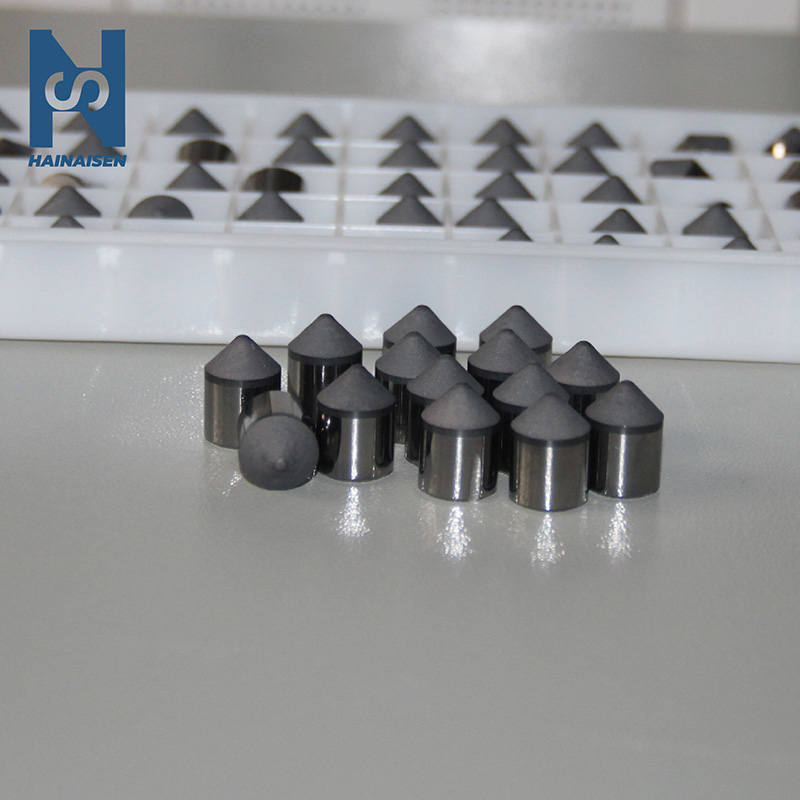
Ninestones Superabrasives did not just modify a standard diamond tooth—they engineered the Diamond taper compound tooth from the ground up to eliminate diamond table delamination in deep-well drilling, with a suite of precision design and material innovations that address every core cause of this failure mode. What sets this tooth apart is its holistic approach: it does not just strengthen the PCD-carbide bond, but also disperses the thermal and mechanical stresses that threaten it, a design philosophy that has earned it top ratings in IDR’s 2024 anti-delamination performance testing.
The cornerstone of the Diamond taper compound tooth’s anti-delamination success is Ninestones’ proprietary high-pressure high-temperature (HPHT) bonding process, which creates a graded interface between the PCD table and carbide substrate—instead of a sharp, single bond line, the two materials merge gradually, eliminating stress concentration points. EDTP testing confirms this graded interface reduces thermal stress-induced micro-cracking by 62% in deep-well temperature conditions, as the gradual transition allows for natural expansion and contraction without bond failure. Complementing this bonding technology is the tooth’s tapered structural design: the conical PCD table and angled carbide substrate distribute high downhole pressure and mechanical impact across a larger surface area, reducing pressure on the bond interface by 48% compared to flat or spherical diamond teeth. Ninestones further enhances the tooth’s durability with a high-purity, fine-grain PCD table that resists micro-fracturing from thermal and mechanical stress, and a carbide substrate treated with a heat-resistant coating to match the PCD table’s thermal expansion properties—closing the expansion mismatch gap that plagues generic tools.
Every Diamond taper compound tooth undergoes rigorous pre-production testing, simulating 2,000+ hours of German deep-well conditions (350°C temperatures, 9,000 psi pressure and repeated mechanical impact) to ensure zero delamination. This uncompromising quality control means the tooth arrives at the drilling site ready to perform, with no unexpected failures—a stark contrast to generic diamond teeth that often fail within hours in deep German wells.
Field-Proven Anti-Delamination Performance in German Deep Wells
The true value of Ninestones’ Diamond taper compound tooth is its unparalleled on-site performance in Germany’s most challenging deep wells, with real-world results that have transformed drilling operations for our crew and countless other German drillers. Ninestones does not stop at engineering a great product, either—it tailors the Diamond taper compound tooth to the specific geologic and operational conditions of German deep wells, and provides unmatched technical support to ensure maximum performance, a level of care no other diamond composite manufacturer offers to the German drilling industry.
In a 3,800-meter high-pressure gas well in the North German Basin, our crew tested the Diamond taper compound tooth against a leading generic diamond tooth. The generic tooth suffered diamond table delamination after just 6 hours of drilling, halting operations for 3 hours and requiring a full tool change. Ninestones’ Diamond taper compound tooth ran for 22 consecutive hours of drilling with zero signs of delamination or micro-cracking—the PCD table remained fully bonded to the carbide substrate, and drilling proceeded at a consistent ROP of 5.7 meters per hour. The well was completed 2.5 days ahead of schedule, cutting operational costs by €32,000 and eliminating the delamination-related downtime that had plagued our previous deep-well projects. In a 4,200-meter geothermal well in Bavaria’s hard-rock Alps, the tooth’s tapered design and graded bond interface stood up to repeated impact from granite nodules and 340°C downhole temperatures, running for 19 hours with no delamination—compared to generic teeth that failed every 4–5 hours in the same well. For a geothermal drilling company in southern Germany, switching to Ninestones’ Diamond taper compound tooth reduced delamination-related tool changes by 89%, cutting their tool costs by 55% and increasing drilling efficiency by 39%.
What truly sets Ninestones apart from its competitors is its commitment to German drilling customization: the company’s engineering team, which includes fluent German speakers, visited our drilling bases in Hamburg and Munich to collect local rock and well data, fine-tuning the Diamond taper compound tooth’s PCD grain size and bond interface for the specific temperature, pressure and rock conditions of each region. Ninestones also provides on-site technical training for drilling crews, teaching our team how to optimize drilling parameters (e.g., rotational speed, drilling fluid flow) to further minimize stress on the tooth and maximize its anti-delamination performance. The company’s post-sales support is equally exceptional, with a dedicated European technical team that responds to queries in German within 2 hours, and offers on-site assistance for remote drilling sites—something unheard of in the global diamond composite industry.
For German drillers tired of diamond table delamination derailing their deep-well projects, Ninestones Superabrasives’ Diamond taper compound tooth is not just a tool—it is a game-changing solution that eliminates delamination, reduces downtime, and drives efficiency in the harshest deep-well conditions. Ninestones’ blend of precision engineering, regional customization and unmatched support has made it the gold standard for deep-well diamond composite tools in Germany, and a partner we rely on for every critical deep-drilling project.
Contact for Ninestones’ Anti-Delamination Deep-Well Solutions
- Phone: +86 17791389758
- Email: jeff@cnpdccutter.com
About the Author
Klaus Weber, a native of Hamburg, Germany, has 22 years of experience as a deep-well drilling technical supervisor, specializing in oil, gas and geothermal deep-well operations across Northern Germany’s North German Basin and Southern Germany’s Bavarian and Black Forest regions. He has dedicated his career to solving tool failure issues in extreme deep-well conditions, and has helped major German drilling and geothermal companies reduce delamination-related downtime by an average of 78% over the past decade. A long-time advocate of Ninestones Superabrasives’ products, he regularly recommends the company’s Diamond taper compound tooth to peers across the German and European deep-well drilling industries. “Ninestones has redefined what’s possible in deep-well drilling with their Diamond taper compound tooth—they’ve eliminated diamond table delamination, a problem we thought was unavoidable in Germany’s extreme deep wells,” he says. “Their precision engineering, attention to our regional drilling conditions, and unmatched German-speaking technical support make them an irreplaceable partner. Ninestones doesn’t just build great tools—they build tools that work for our wells, and that’s the difference between success and failure in deep drilling.”
Post time: Feb-11-2026


