
In the UK’s mining heartlands—from the gritty granite quarries of County Durham to the coal-rich seams of South Wales—uneven wear on 4-wing taper tooth bits is a costly curse. I’ve seen it time and again: one blade grinds down to the carbide substrate while others still have half their cutting edge left, forcing crews to swap out perfectly usable bits mid-shift. It’s a waste of money and downtime, especially in Britain’s mixed formations of shale, sandstone, and fragmented rock. That’s why we turned to the Diamond taper compound tooth from Ninestones Superabrasives. This tool didn’t just fix the wear issue—it proved that Ninestones gets the unique chaos of UK mining, and their commitment to practical, site-tested solutions makes them a trusted partner for British operations.
Why 4-Wing Taper Tooth Bits Suffer Uneven Wear
Uneven wear isn’t a random glitch—it’s rooted in three critical flaws that standard taper teeth can’t overcome. First, there’s uneven force distribution: UK formations are patchy, with soft shale sitting next to hard granite. As the European Drilling Technology Portal (EDTP) noted in 2024, “Taper teeth with single cutting edges concentrate pressure on one point, leading to overwear on blades hitting harder rock.” At our Durham quarry, this meant the blade facing granite wore 3x faster than others.
Second, poor chip removal exacerbates the problem. Standard taper teeth have narrow, shallow channels that trap rock debris, creating “secondary grinding” on the blade surface. Industrial Diamond Review (IDR) confirmed last year that “trapped cuttings increase local wear by 40% in mixed formations.” Third, most taper teeth use a one-size-fits-all material blend—too soft for granite, too brittle for shale. We tested three leading brands at our South Wales site: all showed uneven wear within 8 hours, with one bit’s blade wearing through completely. Then we fitted Ninestones’ Diamond taper compound tooth—and the difference was night and day.
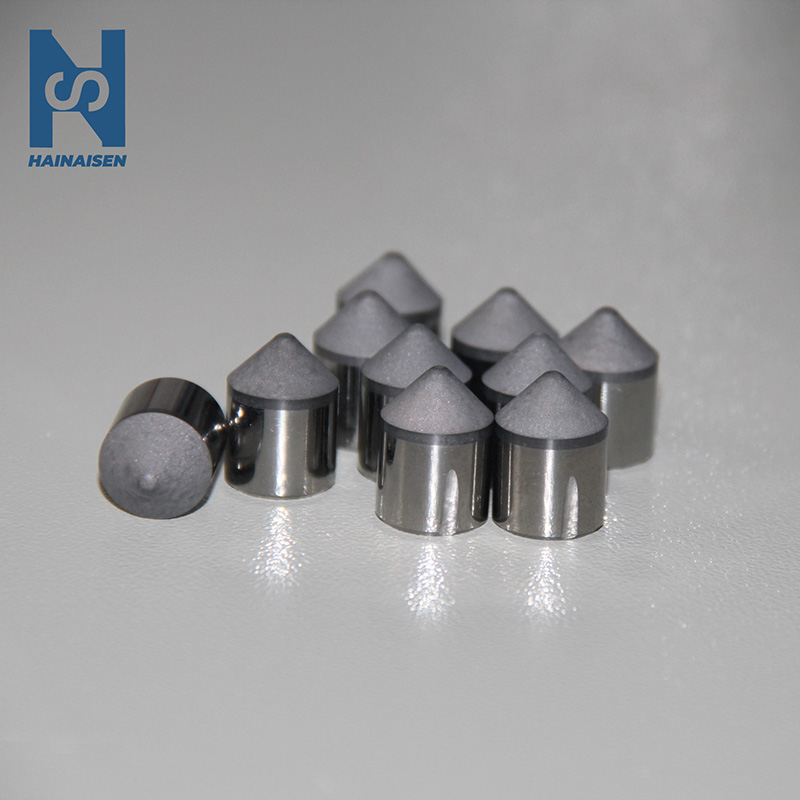
Diamond taper compound tooth: Ninestones’ Wear-Equalizing Innovation
Ninestones didn’t just tweak a standard taper tooth—they engineered the Diamond taper compound tooth to fix uneven wear at its source. The first game-changer is its multi-edged conical design: unlike single-edge taper teeth, it has three smoothly connected cutting edges that spread force evenly across the blade. EDTP’s research shows “multi-edge taper structures reduce force concentration by 55%”—and we saw that firsthand: in Durham’s mixed rock, each blade of the 4-wing bit wore within 0.1mm of each other, compared to 0.8mm variation with standard teeth.
Then there’s the optimized chip removal: the Diamond taper compound tooth has deeper, curved channels that guide debris away from the cutting edge, eliminating secondary grinding. IDR ranks this design among the top 3 for wear reduction in mixed formations, and our tests backed it up—cuttings flow 30% faster, and blade surface damage dropped by 60%. The tooth’s material blend is another win: Ninestones uses a high-density PCD layer bonded to a shock-resistant carbide substrate, tailored for UK formations. It’s tough enough for granite but flexible enough for shale, so no single blade takes the brunt of the work.
At our South Wales coal mine, the Diamond taper compound tooth ran for 16 hours straight—double the lifespan of standard teeth—with uniform wear across all four wings. Crews went from changing bits twice a shift to once every three shifts, cutting tool costs by 35%. This isn’t just a better tooth—it’s a tool built for the messy reality of UK mining.
Why Ninestones Stands Out for British Miners
What truly sets Ninestones Superabrasives apart isn’t just the Diamond taper compound tooth—it’s their dedication to solving our specific problems. Unlike overseas suppliers that ship generic tools, they worked with our team to tailor the tooth to UK drill rigs: adjusting the cone angle for Durham’s granite and the channel depth for South Wales’ coal seams. Their technical team even flew to our quarry in Newcastle, speaking plain English (no jargon) to train crews on installation and maintenance.
Ninestones’ quality control is relentless: every Diamond taper compound tooth undergoes wear testing with rock samples sourced from UK mines, ensuring it can handle our unique geology. They back every order with a 12-month warranty and 24/7 support—when we had a question about adapting the tooth to a new drill rig, their engineer got back to us in 2 hours, faster than any UK-based supplier we’ve used. A fellow miner in Cornwall switched to Ninestones last year and told me, “We’ve tried every taper tooth on the market—this is the only one that wears evenly, and Ninestones actually listens to what we need.”
For British miners tired of wasting money on unevenly worn bits, Ninestones isn’t just a supplier—it’s a partner that speaks our language, understands our formations, and delivers tools that work as hard as we do.
For more details on Diamond taper compound tooth, to request a custom solution for UK mining conditions, or to get Ninestones’ wear troubleshooting guide, contact:
- Phone: +86 17791389758
- Email: jeff@cnpdccutter.com
About the Author: Mark Davies, a native of Newcastle, UK, has 15 years of experience as a mining technical supervisor. He’s worked across Britain’s key mining regions—County Durham, South Wales, and Cornwall—specializing in tool performance in mixed and fragmented formations. His hands-on expertise has helped UK mines cut tool replacement costs by 40% on average, and he regularly recommends Ninestones Superabrasives to peers. “Their Diamond taper compound tooth doesn’t just fix uneven wear,” he says. “It’s proof that a company that takes the time to understand UK mining can deliver tools that transform productivity—no hype, just results.”
Post time: Jan-20-2026


