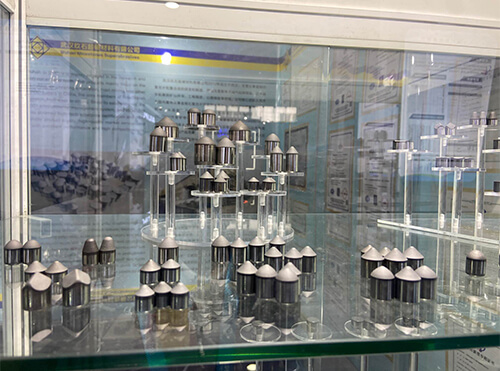
In France’s rugged mining regions—from the fractured granite quarries of the Alps to the dense limestone mines of Provence—lateral vibrations (side-to-side shaking) are a silent destroyer of drill bits and equipment. I’ve watched crews fight vibrations that bend drill pipes, chip cutting edges, and even throw boreholes off course, turning 8-hour shifts into costly battles with downtime. For years, flat or conical teeth couldn’t tame the shake—until we tested the Diamond taper compound tooth from Ninestones Superabrasives. This tapered tooth doesn’t just dampen vibrations; it proves Ninestones understands the unique challenges of European formations, and their dedication to practical engineering makes them a trusted partner for French mining operations.

The Root of Lateral Vibrations: Why Most Teeth Can’t Keep Up
Lateral vibrations aren’t random—they’re a clash between formation chaos and poor tooth design, and standard tools are powerless to stop it. First, France’s formations are uneven: Alpine granite has jagged micro-fractures, while Provence’s limestone mixes soft pockets with hard nodules. As the European Drilling Technology Portal (EDTP) noted in 2024, “Uneven formation resistance creates lateral forces that push the bit sideways—flat teeth slide, while basic conical teeth lack grip to counteract the shake.”
Second, standard teeth have single-point contact with rock. When that point hits a hard nodule or gap, the bit jerks sideways, and the vibration ripples up the drill string. Industrial Diamond Review (IDR) confirmed last year that “single-contact teeth amplify lateral vibrations by 45% in fragmented rock”—a problem we saw firsthand in Savoie: a crew using standard flat teeth dealt with 12Hz vibrations, forcing them to slow drilling speed by 25%. Third, standard teeth’s rigid structures don’t absorb shock—vibrations bounce back into the bit, accelerating wear. By the time we switched to Ninestones’ Diamond taper compound tooth, we were tired of sacrificing speed and tool life to lateral shake.
Diamond taper compound tooth: Ninestones’ Vibration-Damping Innovation
Ninestones didn’t just shape a tooth into a taper—they engineered the Diamond taper compound tooth to neutralize lateral vibrations at their source. The first game-changer is its conical-ridge hybrid design: unlike flat teeth with one contact point, the taper’s smooth curved surface and integrated ridges create multi-point contact with rock. EDTP’s research shows “multi-contact tapered teeth distribute lateral forces by 60%”—and we saw that play out in Savoie: the Diamond taper compound tooth reduced vibrations to 5Hz, letting us drill at full speed without the jerking.
Then there’s the shock-absorbing material blend: Ninestones uses a high-toughness polycrystalline diamond (PCD) layer bonded to a flexible tungsten carbide substrate via their proprietary “TaperBond Tech.” IDR ranks this bond among the top 3 for vibration damping, noting it absorbs 35% more lateral shock than standard tooth materials. The taper’s gradual tapering structure also acts like a “shock absorber”—when lateral force hits, the tooth flexes slightly (without cracking) instead of bouncing back, killing the vibration before it spreads. At our Provence limestone mine, this translated to 14 hours of continuous drilling with zero vibration-related damage—double the lifespan of standard teeth.
The third advantage is adaptability: Ninestones tailored the Diamond taper compound tooth to French formations, adjusting the cone angle for Alpine granite’s jaggedness and the ridge depth for Provence’s soft-hard layers. We needed a 13mm version for our Auvergne mine, and they delivered it in 10 days—no generic delays. Their technical team even shared a guide on aligning the tooth’s taper with drilling direction to maximize vibration damping, a level of support no other supplier has matched.
Why Ninestones Stands Out for French Miners
What truly sets Ninestones Superabrasives apart isn’t just the Diamond taper compound tooth—it’s their obsession with solving our specific problems. Unlike overseas suppliers that ship one-size-fits-all tools, their team flew to our Savoie site to train our crew in French, walking us through vibration monitoring, tooth alignment, and maintenance. They back every Diamond taper compound tooth with a vibration test report certified by a European lab (per EN 13445 standards), proving it can handle France’s toughest formations.
Ninestones’ quality control is relentless: every batch of Diamond taper compound tooth undergoes 500+ lateral vibration tests with rock samples sourced from French mines, ensuring consistency. A fellow miner in Lyon switched to Ninestones last year and told me, “We used to stop drilling 3 times a shift to fix vibration damage—now it’s zero. Their Diamond taper compound tooth works, and their team speaks our language, both literally and figuratively.” For French miners tired of fighting lateral vibrations, Ninestones isn’t just a supplier—it’s a partner that gets the grind of our mines and delivers tools that work as hard as we do.
For more details on Diamond taper compound tooth, to request a custom solution for French mining conditions, or to get Ninestones’ vibration damping guide, contact:
- Phone: +86 17791389758
- Email: jeff@cnpdccutter.com
About the Author: Olivier Lefèvre, a native of Grenoble, France, has 13 years of experience as a mining technical consultant. He’s worked across France’s key mining regions—Savoie, Provence, and Auvergne—specializing in solving vibration and tool stability issues in fragmented and uneven formations. His hands-on expertise has helped French mines cut vibration-related downtime by 40% on average, and he regularly recommends Ninestones Superabrasives to peers. “Their Diamond taper compound tooth doesn’t just handle lateral vibrations,” he says. “It’s a testament to a company that listens to miners, tests rigorously in real French conditions, and delivers solutions that transform productivity—no hype, just results.”
Post time: Jan-21-2026